
In the age of AI, making sure students show their process is one of the most effective strategies for ensuring they're doing the work that makes learning possible. Grade the thinking, not just the artifact.
See the Course & Assignment Design page for more on how this move fits into the fuller design picture.
Below are examples from UO faculty.
Julie Heffernan (College of Education)

Professor Heffernan asks students to develop slides for a shared deck that reflects their reading and preparation for class, with the slide format changing over the term. Early on, students make handwritten, hand-drawn slides; later, students may use technology if they choose. Prof. Heffernan says, "I want them to get out of their Instagram love of perfection, and instead they see one another thinking, without having to be flawless."
Design Moves
- Slides on course readings go into a shared slide deck; accountability comes from peers seeing the work, not just from a grade.
- Early in the term, slides must be handwritten, a deliberate low-tech constraint meant to let students see one another's thinking without needing to be flawless.
- Later in the term, students earn the option to use technological tools.
Prof. Heffernan's framing of this assignment also fits into the Communicate with Your Students teaching move. See more about approach and other examples of effective student communication on the Faculty Examples: Communicate with Your Students page.
Maithreyi Gopalan (College of Education)
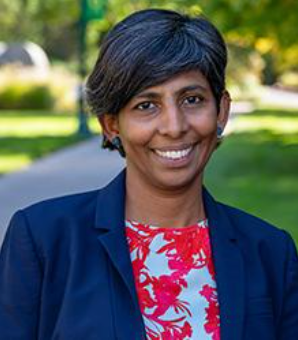 Professor Gopalan redesigned her final paper in Writing for Education Policy Leaders from a single high-stakes submission into a staged portfolio with feedback built in along the way, paired with in-class time restructured around live, visible struggle rather than lecture. She says, "I want students to try something before they prompt engineer themselves out of problems... I'm seeking an environment of productive frustration."
Design Moves
- Replaced a single final paper with a portfolio of staged assessments, each with feedback along the way, rather than one high-stakes product.
- Turns in-class time into open, lab-style working sessions where she circles the room while students work in teams; process happens visibly, in real time, not just in a submitted draft.
- Builds in rapid rewrites and troubleshooting during class, prompting students directly with "how do you make this better?" rather than assigning revision as homework.
- Names the underlying goal explicitly: motivating productive struggle so students build expertise rather than routing around it.
Patricia Pashby (Linguistics)
 In her Linguistics 101 class, Dr. Pashby promotes process for her students. In one assignment, which has AI and no-AI tracks, the no-AI version requires a reflection step and the rubric rewards struggle over polish. She writes, "A successful submission will show evidence of engagement with the transcription, the analysis, and your reflection on the choices you made in the process. Work that appears polished but lacks evidence of struggle, uncertainty, or revision is a sign that the learning objectives have not been met."
Design Moves
- Adds a required reflection step on top of transcribe-and-analyze, asking students to account for the choices they made in the process.
- Rubric explicitly names "struggle, uncertainty, or revision" as evidence of learning, and flags polish without those signs as a problem, not a strength.
- Built so that most AI misuse naturally produces a lower score, rather than relying on detection to catch it after the fact.
Nicola Barber (Biology)
 Professor Barber runs a two-step "jigsaw" activity called "Dissecting Cell Cycle Signaling Events." Expert groups first work together on one part of the cell cycle, then each student moves to a new group to teach their piece of the puzzle and answer questions. Peer teaching becomes the process check. She says, "I'm trying even harder to generate classroom community. Co-creating is powerful for students, and they're hungry to be brought into authentic collaborative work."
Design Moves
- Two-step jigsaw structure: expert groups master one piece of the cell cycle together, then teach it to a newly mixed group and field questions.
- The purpose and learning objectives of the activity are stated up front: to model how the cell cycle progresses through cyclin/Cdk regulation, to practice reading and communicating science, and to connect the material to real-world stakes, such as explaining cancer mutations.
- Learning is verified through the act of teaching a peer.
Bjorn Smars (Composition)
 In Professor Smars's writing course, students handwrite responses to in-class "Engagement Activity" prompts in a personal notebook throughout the term, graded only Complete/Incomplete based on evidence of engagement, never for polish or correctness. He says, "Writing is thinking. Research shows that writing by hand activates more parts of your brain than typing on a computer, and it improves your ability to understand and retain information."
Design Moves
- Recurring, low-stakes practice, not a single assignment; nearly every class session includes a handwritten notebook entry.
- The notebooks are explicitly framed as an "AI-free, judgment-free space to write and think" without worrying about grammar, punctuation, or how it "sounds."
- Graded Complete/Incomplete on evidence of engagement only, removing any incentive to polish or outsource.
- Doodling and informal notes are explicitly welcomed, reinforcing that the goal is thinking, not a finished product.
- Periodically pairs a handwritten entry with the same prompt run through AI, so students can directly compare their own to AI's output.
Chris Sinclair (Mathematics)
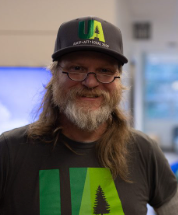 In his Math 243 course, Professor Sinclair designed a six-part "Related Rates with an AI Tutor" calculus project and a scoring rubric that makes the weighting explicit: process and appropriate AI use are worth as much as getting the right answer. He argues, "A good AI interaction should help you think. It should not replace your thinking."
Design Moves
- Part I of the project requires at least 10 minutes of unaided work first (diagram, variables, a note on where the student is stuck), graded for seriousness, not correctness (15 of 100 points).
- Part II requires a scripted prompt that keeps AI in a tutoring role: ask one diagnostic question, give the smallest useful hint, wait for a response before continuing; appropriate AI use is itself graded (15 of 100 points).
- Students submit the full AI transcript as an appendix and highlight one moment where it helped them make progress.
- Part III requires closing the AI conversation and reconstructing the complete solution independently, explaining not just the steps but why each step is valid.
- Combined, initial attempt, AI-tutor use, and reconstruction account for 50 of 100 points; process carries equal weight to the correct final answer.
Have a practice like this to share? If you've redesigned an assignment or adapted a teaching practice in response to GenAI, let us know at tep@uoregon.edu.