
Educational Research in Action is an initiative to make good teaching at UO visible through research. Right now, the community uses the tools of educational research to understand how GenAI is shaping teaching and learning. The goal is to examine how students and instructors are navigating GenAI and what helps good teaching thrive, so that UO's ongoing efforts around AI rest on local evidence rather than assumptions.
The community started in 2024–25 as a workshop series on research skills. In 2025–26 it became a CAIT, and fellows conducted two studies with UO students. In 2026–27 the CAIT continues as part of UO's AI Year of Action, and applications for this year's fellows are open.
AY 26-27: Join This Year's CAIT | AY 25-26: Studying Student Experiences with GenAI | AY 24-25: Building the Community
Join the 2026–27 GenAI Educational Research CAIT
Help bring student voices into UO's curricular change. Open to career and tenure-related faculty; newcomers to research are welcome. Stipend: $1,000 plus OPE. Applications are due Friday, Nov 6 at 11:59 p.m.
Educational Research in Action at a glance
9research skills workshops
118workshop participants
2research studies conducted
60+research showcase attendees
AY 2026-2027: Join This Year's CAIT
This year's Educational Research CAIT is one of the stipended communities of practice in UO's AI Year of Action. It is facilitated by Prof. Jenefer Husman (College of Education) and Dr. Ali Söken (Teaching Engagement Program).
Bringing Student Voices into Curricular Change
TEP is supporting 10–12 academic units as their faculty rethink their curricula in light of GenAI. This year's CAIT will listen to undergraduate students and bring what they say into those unit-level conversations. Together, we will explore how students see the value, relevance, and coherence of their major as GenAI reshapes learning and work.Our IRB-approved study of student motivation and GenAI use also continues this year, with a light role for new fellows.
Who Should Apply
Career and tenure-related faculty teaching in 2026–27. We will select up to 5 fellows. New to research? Please apply. Experience with qualitative research, focus groups, or curriculum work is a plus, but none of it is required. We provide training and pair newer researchers with experienced colleagues.
What Participation Involves
- Meetings: Fridays, 10 a.m.–noon. Kickoff on December 4, 2026, then monthly in winter and spring.
- The work: shaping the research design, conducting focus groups and interviews, and analyzing data as a team.
- Sharing: findings go to participating units and are presented at the AI Year of Action Symposium on June 7, 2027.
The application form includes full details on the study and what participation involves.Apply Now · Applications are due Friday, November 6, 2026, at 11:59 p.m.
AY 2025-2026: Studying Student Experiences with GenAI
In 2025–26, seven faculty and staff fellows from across campus designed and carried out two studies with UO students. Rather than relying on research from other contexts, we asked UO students directly.
Two Studies
Understanding Student Motivation
Survey · Winter–Spring 2026 · 335 undergraduates
What shapes students' decisions about using, or not using, GenAI in their academic work? The survey looked at:
- students' confidence in using GenAI, how much they value it for learning
- the costs and concerns they see, their intentions to use it
- how their motivation in a specific course relates to those beliefs
Navigating GenAI Policies Across Courses
Interviews · Spring 2026 · 10 students
How do students encounter and interpret GenAI policies as they move between courses? The 45-minute interviews explored:
- how policies reach students: syllabi, verbal statements, assignment instructions
- what students do when expectations are unclear, absent, or seem to conflict
- what shapes their choices: clarity, peers, perceived risk, and value
What We Learned
These findings are preliminary, and analysis is ongoing. They describe patterns in UO students' responses, not causes.
From the Survey: Three Student Profiles
- Pragmatic (54%): see both value and cost in GenAI and are aware of its limits. This group is the most responsive to instructor communication.
- Skeptics (24%): see low value and high cost to learning, with strong awareness of GenAI's limitations.
- Enthusiasts (23%): see high value and low cost, with less awareness of GenAI's limitations.
From the Interviews
- Students bring a prior relationship with AI into every course. Their own values and experiences shape how they read a policy.
- Policy lands in that context. Students navigate a patchwork of expectations across disciplines and terms. Policy matters most when it is specific and comes with a rationale.
- Much of students' decision-making is invisible to instructors. Some students stay quiet because asking feels risky. Others rely on their own judgment. From the outside, both look the same. Only 1 in 10 students interviewed described feeling comfortable asking an instructor to clarify AI use.
Research Showcase: What UO Students Are Experiencing
On June 5, 2026, we shared initial findings with more than 60 faculty, GEs, and staff. A panel of five UO students talked about their own experiences navigating GenAI across their courses. Students asked for trust, reasons along with rules, clarity at the assignment level, and room to struggle and learn from failure.
Workshops
Four workshops, 70 participants.
- Nov 2025: Survey Design
- Dec 2025: Qualitative Interviews
- Jan 2026: IRB and Human Subject Research
- May 2026: Practical Strategies for Literature Reviews and Citation Searching
Research Team (2025-2026)
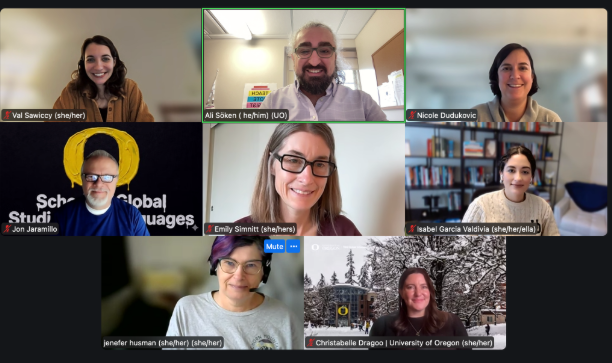
- Ali Söken, Teaching Engagement Program
- Jenefer Husman, Education Studies
- Isabel Garcia Valdivia, Sociology
- Nicole Dudukovic, Psychology & Neuroscience
- Emily Simnitt, English
- Jon Jaramillo, Romance Languages
- Christabelle Dragoo, McNair Scholars Program
- Matt Graham, College of Education
- Val Sawicky, Human Physiology
This research was reviewed and approved by the UO Institutional Review Board (Protocol #STUDY00002187).
AY 2024-2025: Building the Community
In its first year, Educational Research in Action offered five hands-on sessions on core research skills, with 48 participants. The sessions were open to anyone curious about turning a teaching question into something they could study.
- Dec 2024: Educational Research in Action Kickoff
- Feb 2025: IRB and Human Subject Research
- Mar 2025: From Teaching Challenges to Research Questions
- Apr 2025: Designing Effective Surveys
- May 2025: Qualitative Research 101
Are you studying teaching and learning at UO, or do you have a research idea?
Whether you are running a classroom study, collecting student feedback on AI, or just have a question you'd like to investigate, we'd love to hear from you. We can help you connect with colleagues, think through a design, or find a place to share what you're learning.
Contact
Ali Söken, Teaching Engagement Program alisoken@uoregon.edu · 541-346-1182 Join the Educational Research in Action Teams group